
INTRODUCTION
Most job descriptions for senior project manager roles are useless.
They list competencies, frameworks and buzzwords. They tell you what tools you need to know and what methodologies you should be familiar with. But they do not tell you what a senior project manager actually does. Day to day. In practice. When things get difficult.
This guide does.
Based on two decades of project management delivery from support level to Associate Director. Across central government, civil service, police, space agencies and large enterprise environments.
If you want to know what the next level actually looks like, this is it.
THE DIFFERENCE BETWEEN A PROJECT MANAGER AND A SENIOR PROJECT MANAGER
Before getting into what a senior project manager does, it is worth being clear about what makes them different from a project manager.
The difference is not experience alone. Many experienced project managers never make the transition to senior level because they do not change the way they operate.
The difference is in three things.
Scope of accountability. A project manager is accountable for delivering a defined project within agreed constraints. A senior project manager is accountable for delivering outcomes that matter to the organisation. They think beyond the project to the programme, the portfolio and the strategic objectives the project is serving.
Level of stakeholder engagement. A project manager manages relationships with the project team and immediate stakeholders. A senior project manager engages with senior stakeholders, programme boards and sometimes executive leadership. They can hold their own in rooms where the stakes are high and the decisions are significant.
Degree of independence. A project manager typically operates under close supervision and escalates decisions regularly. A senior project manager operates with significantly more independence. They make decisions. They manage exceptions. They bring solutions rather than problems.
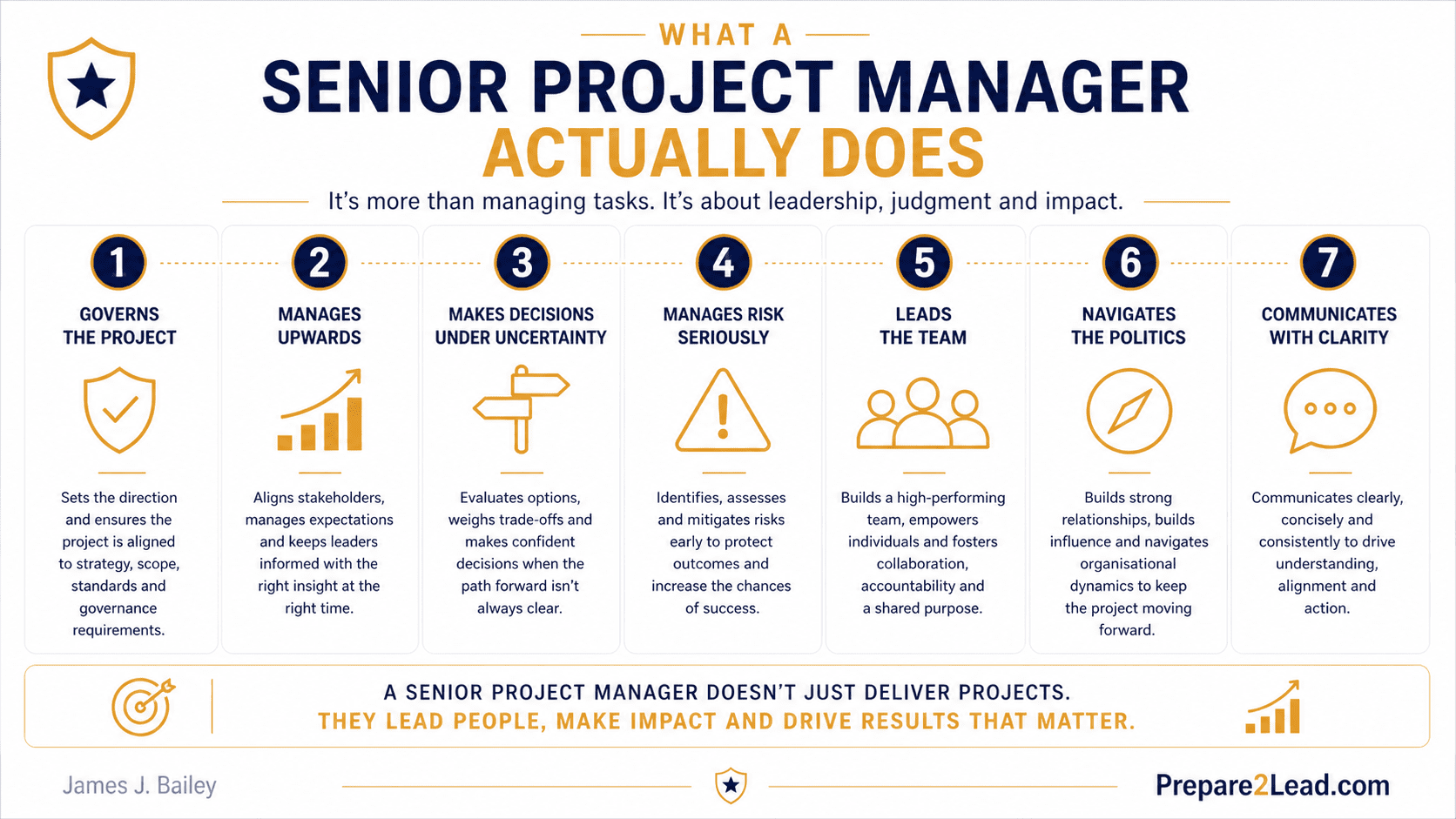
WHAT A SENIOR PROJECT MANAGER ACTUALLY DOES
Governs the project, not just delivers it.
A senior project manager does not just track tasks and manage a plan. They govern the project. They own the governance framework. They ensure the project is justified, controlled and aligned with the organisation’s objectives throughout its lifecycle.
This means owning the business case. Not just knowing it exists but actively using it to guide decisions. If the project is no longer delivering value, a senior project manager will say so. And they will have the evidence to back it up.
Manages upwards as well as downwards.
A senior project manager manages their team. But they also manage upwards. They manage the project board. They manage senior stakeholders. They manage the relationship between the project and the wider programme or portfolio.
This means producing clear, concise reporting that gives senior stakeholders the information they need to make good decisions. Not burying them in detail. Not hiding problems. Giving them a clear picture of where the project is, what the risks are and what decisions need to be made.
Makes decisions under uncertainty.
Projects are uncertain by nature. Things go wrong. Plans change. Assumptions prove incorrect.
A senior project manager makes decisions under uncertainty. They do not wait for perfect information. They use the information available, apply good judgement and act. They manage the consequences of their decisions and learn from them.
This is one of the biggest differences between a project manager and a senior project manager. The willingness and ability to make a call when the situation is ambiguous.
Manages risk seriously.
Every project has risks. Most project managers log them. Senior project managers actively manage them.
That means understanding which risks genuinely threaten the project objectives and which are noise. It means having risk owners who are actually accountable for managing their risks. It means escalating the right risks at the right time to the right people. And it means making sure the project board has the information it needs to make informed decisions about risk.
Leads and develops the team.
A senior project manager is a leader, not just a manager. They develop the capability of the people around them. They create an environment where team members can do their best work. They address performance issues when they arise and recognise good performance when they see it.
They also develop the next generation. They give team members exposure to senior conversations and governance environments. They brief people before important meetings and debrief them afterwards. They create opportunities for people to demonstrate capability at a level above their current grade.
Manages the politics.
Senior project delivery is political. There are competing priorities. Conflicting stakeholder interests. Organisational dynamics that affect what is possible.
A senior project manager navigates this effectively. They understand the political landscape. They manage relationships carefully. They know when to push and when to wait. And they keep the project moving forward despite the politics rather than being stopped by them.
Communicates with clarity and confidence.
A senior project manager can walk into any room and communicate clearly. With the project team. With the project board. With executive leadership. With external stakeholders.
They do not hedge. They do not waffle. They give clear, structured, confident answers to difficult questions. Even when the answer is that something has gone wrong and here is what they are doing about it.
This is perhaps the single most visible difference between a project manager and a senior project manager. The ability to communicate with clarity and confidence at any level.
WHAT SENIOR PROJECT MANAGERS ARE RESPONSIBLE FOR
In practice, a senior project manager is typically responsible for:
Owning and maintaining the project business case. Managing the project governance framework including stage boundaries and exception management. Producing and maintaining the project plan across all stages. Managing the project budget and reporting financial progress accurately. Managing the project risk register actively and escalating appropriately. Producing clear, accurate highlight reports for the project board. Managing relationships with senior stakeholders and the project board. Leading and developing the project team. Managing third party suppliers and contractors where relevant. Ensuring quality standards are met throughout delivery. Identifying and managing dependencies with other projects and programmes. Reporting to programme level where the project sits within a wider programme.
THE SKILLS THAT MAKE THE DIFFERENCE
Technical project management skills are the foundation. But the skills that make the difference at senior level are different.
Structured thinking. The ability to take complex, ambiguous situations and impose structure on them. To break problems down. To identify what matters and what does not. To create clarity from confusion.
Stakeholder management. The ability to understand what different stakeholders need, manage their expectations effectively and build relationships that support delivery rather than obstruct it.
Written and verbal communication. The ability to produce clear, concise written reports and to communicate verbally with confidence at senior levels. This is the skill that most project professionals need to develop most deliberately.
Commercial awareness. An understanding of how the project connects to the commercial and financial objectives of the organisation. The ability to think about value and return on investment, not just delivery.
Leadership. The ability to motivate, develop and lead a team. To create an environment where people do their best work. To hold people accountable fairly and to recognise and develop talent.
HOW TO MAKE THE TRANSITION
If you are a project manager who wants to become a senior project manager, the transition requires deliberate effort.
Start operating at the next level before you have the title. Take on governance responsibilities where you can. Engage with senior stakeholders. Produce reporting at a higher level than your role requires. Develop your communication deliberately.
Get strategic about your qualifications. PRINCE2 Practitioner is the natural foundation for senior project management. MSP Foundation is worth considering if programme management is your next step.
Make your ambition known. Tell your manager you want to develop towards a senior role. Ask what they need to see from you.
And join a community of project professionals who are on the same journey. Learning from each other. Supporting each other. Advancing together.
HOW PREPARE2LEAD CAN HELP
Prepare2Lead exists to help project management professionals advance their careers strategically.
Our free community gives you access to practical career progression resources, training videos and direct access to a senior practitioner who has done this work at every level.
Our certification courses give you the frameworks and credentials to communicate at senior level with confidence.
Join free at prepare2lead.com/community. No credit card. No commitment.
SUMMARY
A senior project manager governs the project, not just delivers it. They manage upwards as well as downwards. They make decisions under uncertainty. They manage risk seriously. They lead and develop their team. They navigate the politics. And they communicate with clarity and confidence at any level.
The transition from project manager to senior project manager is not just about experience. It is about deliberately developing the competence, communication and credibility that senior level roles require.
Start operating at the next level before you have the title. That is how the transition happens.
Follow James on LinkedIn for practical project management career content every week: linkedin.com/in/jamesbailey-uk