
INTRODUCTION
Most advice about getting promoted in project management is wrong.
It tells you to work harder. Deliver more. Be more visible. Get a certification. Build your network.
None of that is wrong exactly. But none of it gets to the real reason why capable project management professionals get passed over.
The real reason is simple. They are not trusted with more.
Not because they are not capable. Not because they do not work hard. But because the people who make promotion decisions do not yet trust them to operate at the next level.
This guide is about changing that. Based on two decades of project management delivery from support level to Associate Director. And years of watching capable people get passed over while less capable people advance.
WHAT ACTUALLY DETERMINES PROMOTION
Before you can change your situation you need to understand what promotion is actually based on.
It is not based on how hard you work. Everyone works hard. Working hard is the baseline expectation, not a differentiator.
It is not based on how long you have been doing the job. Tenure is not a proxy for capability. Organisations promote people who demonstrate they are ready for the next level, not people who have been waiting longest.
It is not based on your qualifications alone. A qualification proves you understand a framework. It does not prove you can operate at the next level. Many highly qualified project managers never get promoted because they cannot demonstrate the thing that actually matters.
What actually determines promotion is this.
Trust.
Specifically, the trust of the people who make promotion decisions that you can think, communicate and operate at the next level. Before they give you the title. Before they give you the salary. Before they take the risk.
If they trust you, you get promoted. If they do not, you do not. Everything else is noise.
The question then is how do you build that trust.
THE THREE THINGS THAT BUILD TRUST
Trust at the promotion level is built from three things working together.
Competence
You need to be genuinely good at doing the work. Not just completing tasks. Understanding what the work is trying to achieve, how it connects to the bigger picture and what good looks like at each stage.
Competence is the foundation. Without it nothing else works. But competence alone is not enough. Plenty of highly competent project professionals never get promoted because they are missing the other two.
Communication
You need to be able to articulate your thinking clearly and confidently. In meetings. In reports. In conversations with senior stakeholders. Under pressure. When things go wrong as well as when things go right.
This is where most capable project professionals fall short. They know what they are doing. They can deliver. But they cannot communicate it in a way that builds confidence in the people who matter.
Communication is a skill. It can be developed. But it requires practice and deliberate effort.
Credibility
You need to be seen as someone who operates at the next level. Not just someone who does the current job well.
Credibility comes from how you show up. How you handle difficult situations. How you engage with senior stakeholders. How you present yourself in governance meetings. How you frame problems and recommendations.
Credibility is built over time through consistent behaviour. But it can be accelerated by deliberately putting yourself in situations where you have to operate at the next level.
WHAT MOST PROJECT MANAGERS GET WRONG
Most project managers focus almost entirely on competence. They learn more. They get more qualifications. They deliver more projects.
And then they wonder why they are not getting promoted.
The answer is usually that their communication and credibility are not keeping pace with their competence. They know their stuff but they cannot demonstrate it in the moments that matter.
Here is a specific example.
A project manager is in a steering group meeting with the programme director and two senior business stakeholders. A risk is raised that could delay a key milestone. The project manager knows exactly what needs to happen. But they hesitate. They defer to others. They wait to be asked rather than stepping up and leading.
The programme director notices. Not that the project manager was incompetent. But that they were not ready to operate at the next level.
That moment costs more than any number of successful deliveries can earn back.
HOW TO ACTUALLY GET PROMOTED
Here is the practical guide. Based on what actually works.
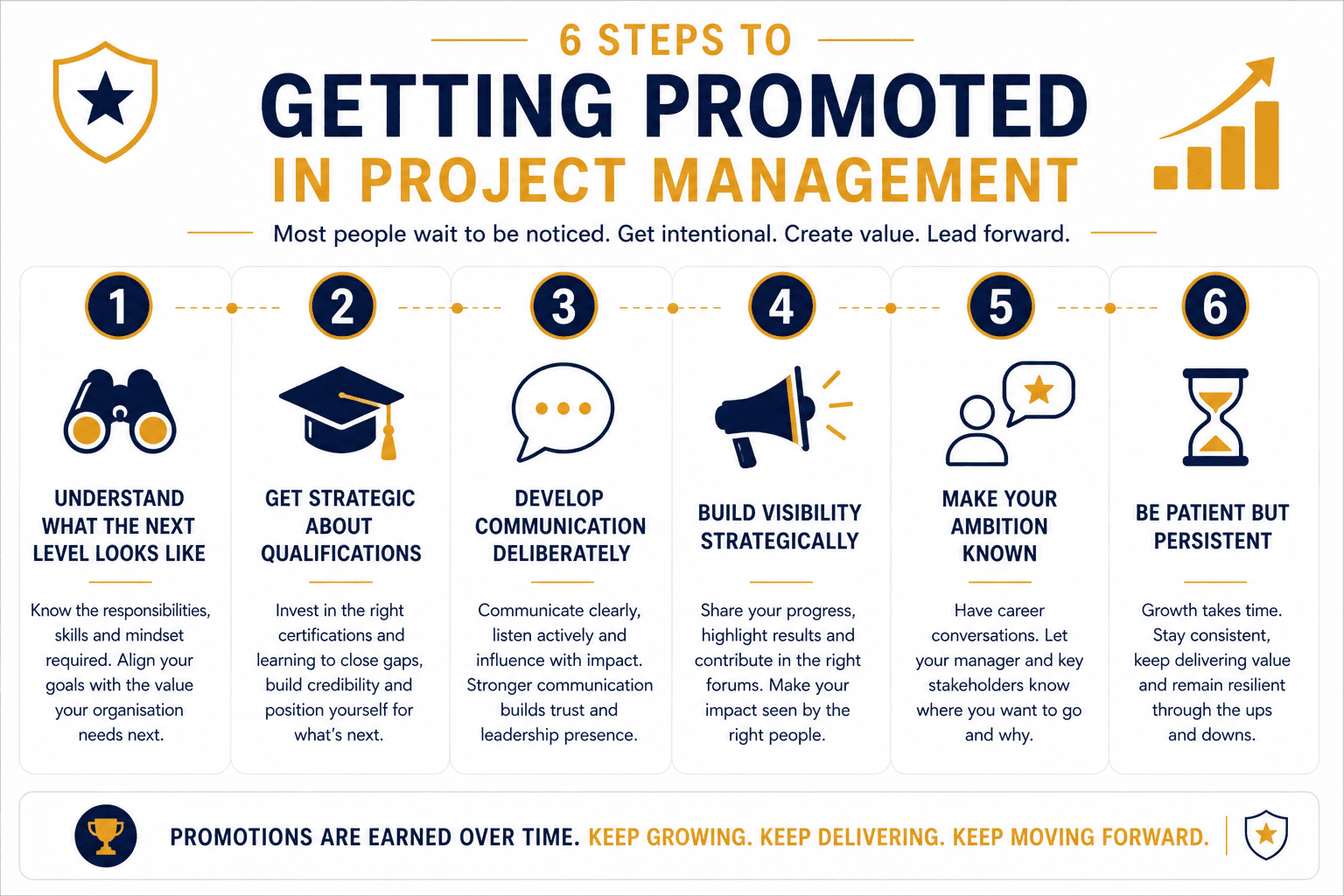
Step 1. Understand what the next level looks like.
Before you can demonstrate you are ready for the next level, you need to know what the next level actually requires. Not the job description. The real thing.
What decisions does someone at that level make? What information do they need? What do senior stakeholders expect from them? What does good look like at that level?
The best way to find out is to observe the people who are already there. Watch how they communicate. Watch how they handle difficult situations. Watch what they focus on and what they delegate.
Then start doing those things. Before you have the title.
Step 2. Get strategic about your qualifications.
Qualifications matter. Not because they prove you can do the job. But because they give you the frameworks and language to communicate at the next level.
PRINCE2 is a good example. Understanding PRINCE2 deeply gives you a structured way of thinking about projects that senior stakeholders recognise and respect. It gives you the vocabulary to participate in governance conversations with confidence.
But choose your qualifications strategically. Do not just collect them randomly. Identify the gap between where you are and where you want to be and choose the qualification that closes that specific gap.
If you want to move from project manager to programme manager, MSP is more relevant than another PRINCE2 qualification. If you work in government and risk management is a key part of the next level role, M_o_R is worth considering.
Step 3. Develop your communication deliberately.
Communication at senior level is a skill. It needs to be practised.
The best way to develop it is to put yourself in situations where you have to communicate at a level above your current grade. Present in governance meetings. Write reports for senior stakeholders. Volunteer to brief the project board. Take on any opportunity to communicate at a higher level than your current role requires.
Each of these experiences builds the muscle. Over time it becomes natural. You stop hesitating. You start leading.
Step 4. Build visibility strategically.
You cannot be promoted by people who do not know you exist.
Visibility does not mean self promotion. It means being seen doing the right things in the right rooms. Contributing in governance meetings. Being the person who brings clarity when things are ambiguous. Being known as someone who can be trusted to represent the team at a senior level.
This is different from simply working hard in your lane. Visibility requires deliberately expanding the scope of your engagement beyond your immediate responsibilities.
Step 5. Make your ambition known.
Many project professionals assume their manager knows they want to be promoted. Often they do not.
Have the conversation. Tell your line manager or sponsor directly that you want to develop towards the next level. Ask what they need to see from you. Ask what gaps they perceive. Ask what opportunities exist to demonstrate readiness.
This conversation serves two purposes. It makes your ambition visible. And it gives you specific information about what you need to do to get there.
Connect with James on LinkedIn for weekly project management career insights: linkedin.com/in/jamesbailey-uk
Step 6. Be patient but persistent.
Promotion in project management is rarely instant. Trust takes time to build. Opportunities take time to emerge.
But if you are consistently developing your competence, communication and credibility, and you are making your ambition known, the right opportunity will come.
The key is not to stop. Keep developing. Keep showing up. Keep demonstrating you are ready. And when the opportunity comes, you will be in the best possible position to take it.
HOW PREPARE2LEAD CAN HELP
Prepare2Lead exists to help project management professionals advance their careers strategically.
Our free community gives you access to practical career progression resources, training videos and direct access to a senior practitioner who has done this work at every level from support to Associate Director.
Our certification courses give you the frameworks and credentials to communicate at the next level with confidence.
Join the free community at prepare2lead.com/community. No credit card. No commitment.
Or browse our certification courses and take the strategic step that closes the gap between where you are and where you want to be.
Find out more about our mission and why Prepare2Lead exists
SUMMARY
Getting promoted in project management is not about working harder. It is about building trust.
Trust comes from demonstrating competence, communication and credibility at the next level before you have the title.
Understand what the next level looks like. Get strategic about your qualifications. Develop your communication deliberately. Build visibility strategically. Make your ambition known. And be patient but persistent.
Do those things consistently and promotion will follow.