
INTRODUCTION
Most project managers have heard the term stage gate.
Fewer can explain what it actually is, why it exists and what should happen at one.
This post gives you the honest practical answer. Based on two decades of delivering projects and programmes across central government, civil service, police and space agencies.
WHAT IS A STAGE GATE?
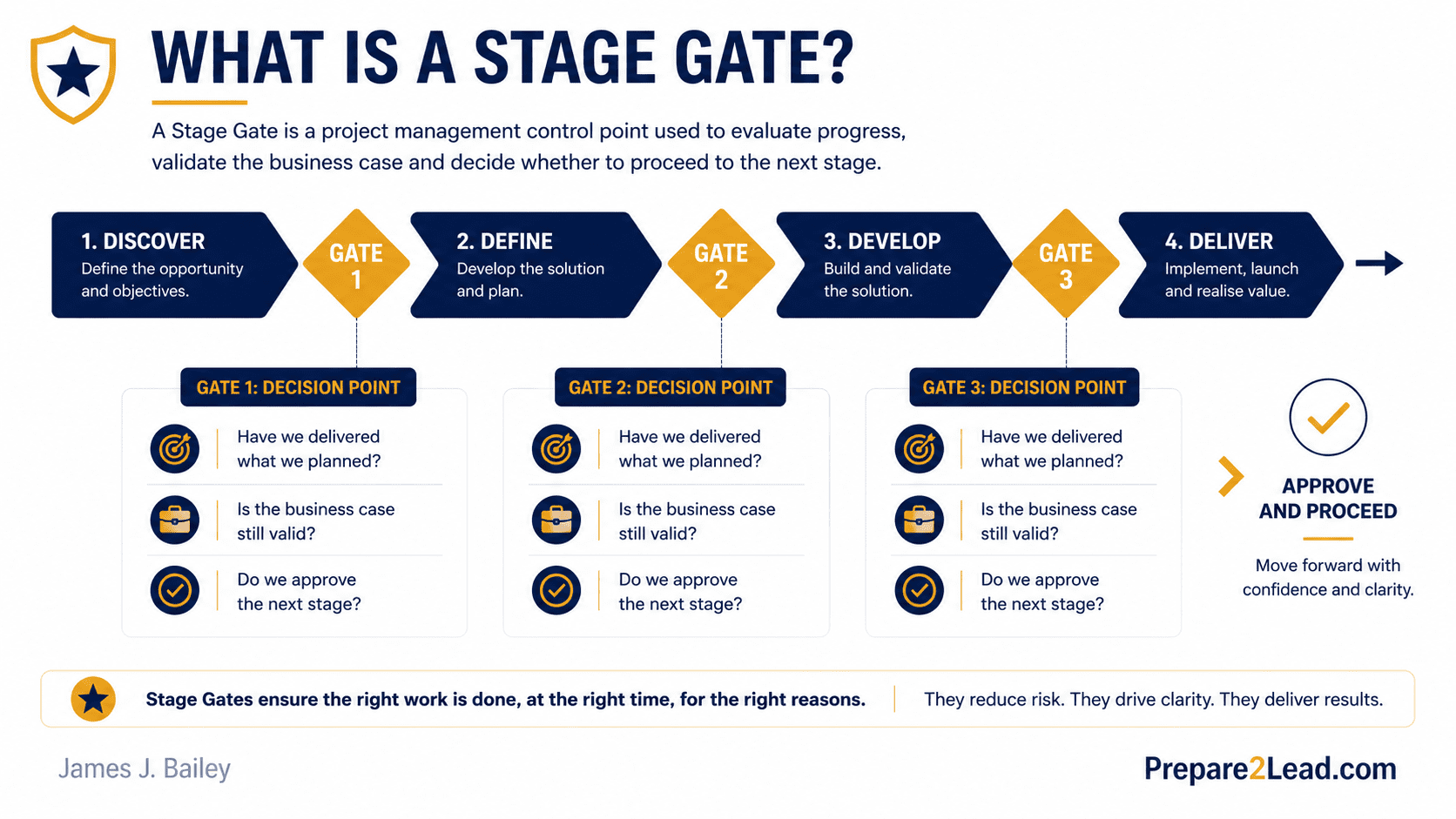
A stage gate is a formal decision point at the end of a project stage.
It is the moment where the project stops. Looks back at what has been delivered. Assesses whether the project is still justified. And decides whether to continue, adjust or stop.
In PRINCE2, stage gates are built into the framework through the Manage By Stages principle and the Managing a Stage Boundary process. They are not optional. They are the mechanism that keeps projects under control throughout their lifecycle.
Think of a stage gate as a structured pause. Not a delay. A deliberate moment of assessment before committing resources to the next phase of delivery.
WHY DO STAGE GATES EXIST?
Stage gates exist because projects are uncertain by nature.
At the start of a project you do not have perfect information. You know what you want to achieve. You have a plan. You have a budget. But as delivery progresses, things change. Assumptions prove incorrect. Costs shift. Dependencies change. The business environment evolves.
Without stage gates, projects press on regardless. They keep spending. Keep delivering. Even when the original justification no longer holds. Even when what is being built is no longer what the business needs.
Stage gates force the question. Is this project still worth doing? Is the original business case still valid? Has anything changed that requires us to adjust our approach?
That question is uncomfortable. It takes courage to ask it honestly. But it is the question that separates well governed projects from projects that waste money delivering the wrong thing.
WHAT HAPPENS AT A STAGE GATE?
At a stage gate, the project manager prepares a report for the project board. This is called an End Stage Report in PRINCE2.
The End Stage Report covers:
What was delivered in the stage just completed. How delivery compared to what was planned. Time. Cost. Quality. Scope. What risks and issues emerged during the stage. Whether the project business case is still valid. A plan for the next stage in sufficient detail for the board to assess it. A high level view of the remaining stages beyond that.
The project board then meets to review this information. They ask three fundamental questions.
Have we delivered what we said we would in this stage? Has anything changed that affects the overall project justification? Are we confident enough in the next stage plan to approve it?
If the answers are satisfactory, the board approves the next stage and the project continues.
If something has changed significantly, the board may request adjustments before approving.
If the project is no longer justified, the board has the authority and the responsibility to stop it.
THE DIFFERENCE BETWEEN A STAGE GATE AND A MILESTONE
These two terms are often confused. They are not the same thing.
A milestone is a point in the plan that marks the completion of a significant deliverable or event. It is a planning and tracking tool. It tells you when something significant has been achieved.
A stage gate is a governance decision point. It is where authority is exercised. Where the project board formally reviews progress and approves or withholds approval for the next stage.
A milestone might trigger a stage gate. But a milestone alone is not a stage gate.
The key difference is authority. At a stage gate, the project board makes a formal decision. At a milestone, the project manager records an achievement.
HOW MANY STAGE GATES SHOULD A PROJECT HAVE?
This depends on the size, complexity and risk profile of the project.
PRINCE2 does not prescribe a fixed number of stages. It says projects should be planned and delivered in stages that reflect the natural decision points in the project lifecycle.
As a general guide:
A small low risk project might have one or two stages and therefore one or two stage gates. A medium complexity project might have three to five stages. A large complex programme might have many more, with stage gates timed around significant deliverables, funding decisions or governance reviews.
The principle is that stage gates should happen often enough to maintain meaningful control without being so frequent that they create bureaucratic overhead.
If you are holding stage gates every two weeks on a two year programme, you are probably over-governing. If you are holding one stage gate at the very end of an eighteen month delivery, you are under-governing.
WHAT MAKES A GOOD STAGE GATE?
A good stage gate is:
Prepared properly. The End Stage Report gives the board the information they actually need to make a decision. Not buried in detail. Not vague on the issues. Clear, honest and complete.
Attended by the right people. The project board members who have the authority to make decisions are present. Not delegated to someone who cannot actually approve the next stage.
Honest. The project manager presents the reality of what happened in the stage. Not a sanitised version that makes everything look better than it was. Boards that only hear good news make bad decisions.
Decisive. The board makes a clear decision at the end of the gate. Approve. Adjust. Stop. Not a vague agreement to continue with caveats that nobody follows up on.
Documented. The decision and the basis for it are recorded. If things go wrong later, there is a clear record of what was known at the time and what was decided.
STAGE GATES AND YOUR CAREER
Understanding stage gates is one of those things that separates project managers who just deliver tasks from project managers who understand governance.
When you can explain what a stage gate is, why it exists and what should happen at one, you demonstrate that you understand how projects are governed at board level. Not just how they are managed day to day.
That understanding is what senior roles require. Programme managers. PMO leads. Senior project managers. All of them need to engage with project boards confidently. All of them need to understand the governance mechanisms that sit above the delivery level.
PRINCE2 Foundation gives you that understanding. PRINCE2 Practitioner tests whether you can apply it in practice.
If you want to develop your project management governance knowledge and advance your career strategically, the Prepare2Lead community is a good place to start.
👉 Join free at prepare2lead.com/community
SUMMARY
A stage gate is a formal governance decision point at the end of a project stage. It is where the project board reviews what has been delivered, assesses whether the project is still justified and approves the next stage.
Stage gates exist because projects are uncertain. They provide the mechanism to check that the project is still going in the right direction before committing more resources to it.
A good stage gate is prepared properly, attended by the right people, honest, decisive and documented.
Understanding stage gates is a sign that you understand project governance. And project governance is what senior roles are built on.