
INTRODUCTION
Most business cases fail before they are even read.
Not because the project is a bad idea. Not because the numbers do not stack up. But because the document does not give the people who need to approve it the information they need to say yes.
This post gives you the practical guide to writing a PRINCE2 business case that actually gets approved. Based on two decades of writing, reviewing and approving business cases across central government, civil service, police and space agencies.
WHAT IS A PRINCE2 BUSINESS CASE?
In PRINCE2, the business case is the central document that justifies the project throughout its entire lifecycle.
It is not a one off document produced at the start and filed away. It is a living document that is reviewed and updated at every stage gate. It answers the fundamental question that PRINCE2 keeps asking throughout the project.
Is this project still worth doing?
If the business case cannot answer that question clearly and convincingly at any point in the project lifecycle, the project board has grounds to stop the project.
That is the power of the business case. And that is why getting it right matters.
WHAT A BUSINESS CASE IS NOT
Before getting into what to include, it is worth being clear about what a business case is not.
It is not a project plan. The project plan describes how the project will be delivered. The business case describes why it should be.
It is not a requirements document. Requirements describe what the project will build. The business case describes what value that will generate.
It is not a project initiation document. The PID covers a wide range of project governance information. The business case is specifically focused on justification and value.
Keeping these things separate is important. A business case that tries to do everything becomes unwieldy and loses its core purpose.
THE FIVE CASE MODEL
If you are working in UK government or public sector, you will almost certainly need to use the Five Case Model. This is the HM Treasury framework for developing and presenting business cases. It is the standard for all significant public sector investment decisions.
The five cases are:
Strategic case. Why does the organisation need to do this? How does it align with strategic objectives? What is the problem or opportunity being addressed?
Economic case. What are the options? How have they been assessed? Which option delivers the best value for money?
Commercial case. How will the project be procured? What is the contracting strategy? What are the commercial risks?
Financial case. What will it cost? How will it be funded? What is the financial impact on the organisation?
Management case. How will the project be governed and delivered? What is the plan? Who is accountable?
Even if you are not in the public sector, the Five Case Model is an excellent structure for any business case. It forces you to think through all the dimensions of the investment decision rather than just the financial one.
WHAT TO INCLUDE IN YOUR PRINCE2 BUSINESS CASE
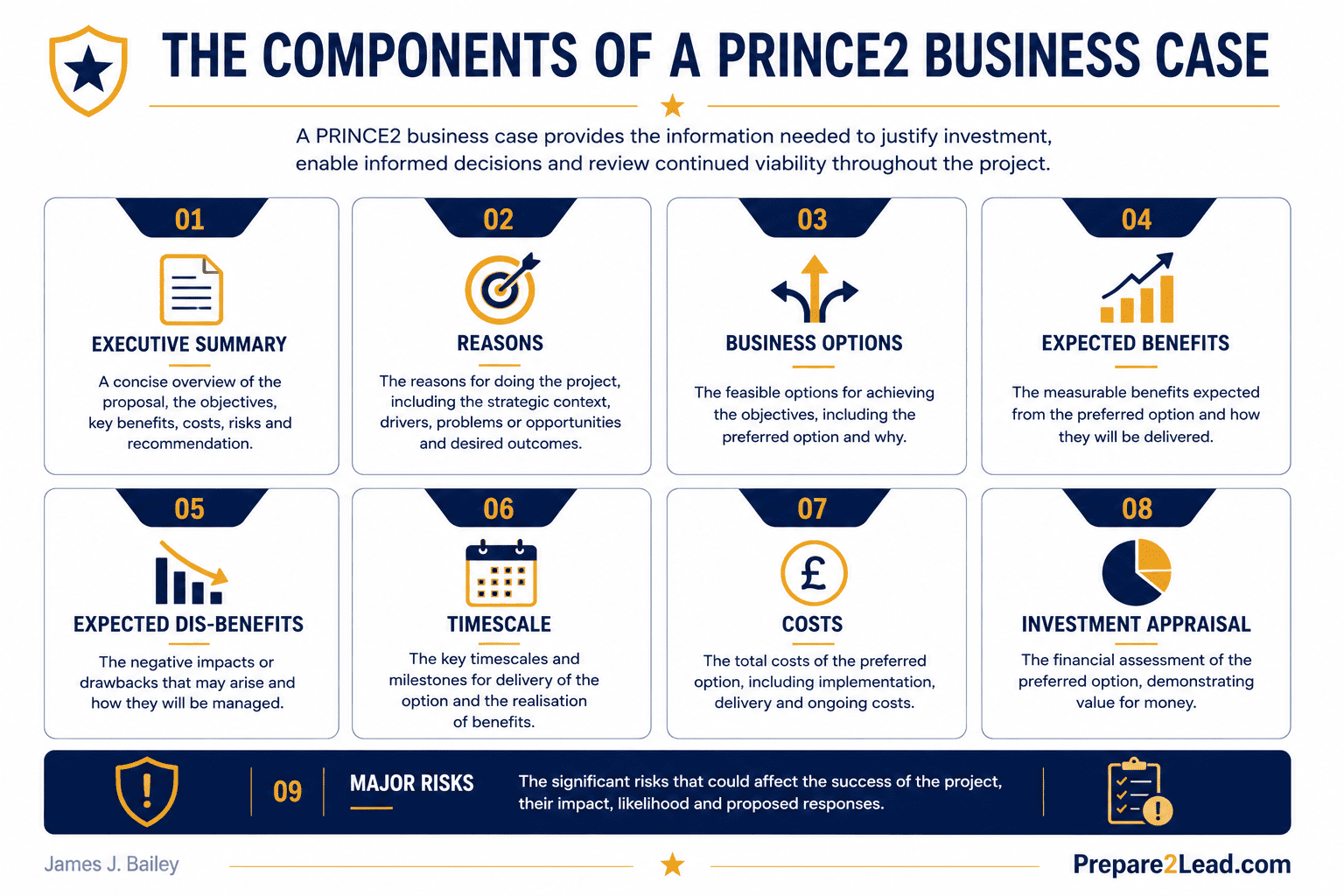
PRINCE2 defines the contents of the business case clearly. Here is what every PRINCE2 business case should contain:
Executive summary A concise summary of the whole document. Written last but placed first. Two to three paragraphs maximum. The decision makers who read this are busy. Many of them will read only the executive summary. Make it count.
Reasons Why is this project being proposed? What problem is it solving? What opportunity is it exploiting? This section must be compelling. If the reader does not understand why the project matters after reading this section, the rest of the document will not save it.
Business options What options were considered? At minimum you should present three options. Do nothing. Do the minimum. Do the recommended option. Show that you have genuinely considered alternatives rather than just justifying a predetermined decision.
Expected benefits What measurable improvements will result from this project? Benefits should be specific, measurable and attributable to the project. Vague benefits like improved efficiency or better customer experience are not sufficient. How much efficiency? Measured how? By when?
Expected dis-benefits What negative consequences might result? Honest business cases acknowledge dis-benefits. A system migration might temporarily reduce productivity. A restructure might affect morale. Acknowledging these builds credibility with reviewers.
Timescale When will the benefits be realised? Some benefits are immediate. Others take years to materialise after the project closes. The timescale section maps the benefits realisation profile over time.
Costs What is the total cost of the project? This should include all costs. Development costs. Implementation costs. Transition costs. Ongoing operational costs if relevant. Do not underestimate costs to make the business case look more attractive. Underestimated costs destroy trust.
Investment appraisal How do the benefits compare to the costs over time? This typically includes a cost benefit analysis, a return on investment calculation and sometimes a net present value calculation for longer term investments. The investment appraisal answers the fundamental financial justification question.
Major risks What are the principal risks that could affect the realisation of the expected benefits? This is not a risk register. It is a high level summary of the risks that are most significant to the business case. Three to five risks with a brief description of their potential impact on the expected benefits.
THE MOST COMMON MISTAKES
Benefits that are not measurable Vague benefits kill business cases. If you cannot measure a benefit you cannot demonstrate it has been delivered. Every benefit in your business case should have a baseline, a target and a measurement method.
Costs that are too optimistic Underestimating costs is one of the most common and most damaging mistakes. It happens because people want the business case to look attractive. But a business case that approves a project at £2 million and delivers at £5 million destroys the credibility of everyone involved. Be honest. Add contingency. Explain your assumptions.
No genuine options appraisal If your options are do nothing, do a tiny bit, and do exactly what we were always going to do, reviewers will notice. Genuine options appraisal considers meaningfully different approaches and assesses them objectively. It is harder to write but far more convincing.
An executive summary that requires reading the rest The executive summary should stand alone. It should give decision makers who read nothing else enough information to understand why the project is being proposed, what the recommended option is, what it will cost, what benefits it will deliver and what the main risks are. If reading the executive summary raises more questions than it answers, rewrite it.
Ignoring the audience Different reviewers care about different things. Finance directors care about costs and financial returns. Operations directors care about implementation impact. Risk managers care about the risk profile. Write your business case for its audience. Put the things they care most about front and centre.
HOW THE BUSINESS CASE EVOLVES THROUGH THE PROJECT
In PRINCE2, the business case is not static. It evolves throughout the project lifecycle.
At project initiation, the business case is developed in detail as part of the Project Initiation Documentation.
At each stage gate, the business case is reviewed and updated. Has anything changed that affects the expected costs or benefits? Are the projected benefits still realistic? Is the project still justified?
If a significant change occurs during the project that materially affects the business case, an exception report is raised and the business case is reviewed out of cycle.
At project close, the business case is used to establish the benefits realisation plan. The project may have ended but the benefits may take months or years to be fully realised. The post-project benefits reviews check whether the expected benefits are actually materialising.
This continuous review is what makes the PRINCE2 business case genuinely useful as a governance tool rather than just a box-ticking exercise.
A NOTE ON BETTER BUSINESS CASES
If you work in UK central government or are involved in significant public sector investment decisions, the Better Business Cases qualification is worth considering alongside PRINCE2.
Better Business Cases is a certification specifically focused on the Five Case Model. It is recognised by HM Treasury and is increasingly required for senior roles involved in public sector investment appraisal.
I hold the Better Business Cases Practitioner certification. It was the qualification that unlocked a contract at £950 a day with the UK Space Agency. Not because passing the exam got me the job. Because understanding the framework allowed me to have investment appraisal conversations at a level that most project professionals cannot.
That is what strategic certification looks like in practice.
HOW PREPARE2LEAD CAN HELP
Prepare2Lead offers PRINCE2 Foundation and Practitioner certification at prices that beat PeopleCert even on their 30 percent sale days. Every product includes Take2, a free resit if you fail your first attempt.
Understanding the PRINCE2 business case starts with Foundation. Applying it in practice is what Practitioner develops.
👉 Join the free community at prepare2lead.com/community and browse the courses.
SUMMARY
A PRINCE2 business case is not a one off document. It is a living justification that is reviewed throughout the project lifecycle.
A good business case includes a compelling reasons section, genuine options appraisal, measurable benefits, honest costs, an investment appraisal and a clear summary of major risks.
The most common mistakes are vague benefits, optimistic costs, weak options appraisal and an executive summary that does not stand alone.
Getting your business case right is not just a documentation skill. It is a governance skill. And governance skills are what senior project management roles are built on.